Sunday, June 7, 2009

God is a Family--A Reflection on Trinity Sunday


Last week was the feast of Pentecost, the birth of the Church. This week, we celebrate the feast of the Holy Trinity. The week after that will be Corpus Christi, the most holy Body and Blood of Christ. In putting these feasts one right after the other, the Church is pointing to the heart of Christian Truth: the Spirit, the Father and the Son: the Trinity.

The Trinity is the key doctrine of our faith. Our God is one God. We share that with Judaism and Islam. Our God is three persons in that one God. Judaism and Islam would both deny that. Why is the Trinity so important?

First, it is taught in Scripture. You won’t find the word Trinity, but the teaching of it can be found throughout the Bible. We started the Mass by quoting 2 Corinthians 13:13 “The grace of the Lord Jesus Christ, the love of God and the fellowship of the Holy Spirit be with you all.” In 1 Peter 1:2 Peter tells his readers that they have been chosen “in the foreknowledge of God the Father, through sanctification by the Spirit for obedience and sprinkling with the blood of Jesus Christ…” Second it is taught by the Church Fathers such as Clement, Justin Martyr and Athanasius. Third, it is taught by the Church in its creeds, councils and liturgy.

Today’s gospel from St. Matthew contains a very early baptismal formula. Jesus tells the disciples to make disciples of all the nations, baptizing them in the name of the Father, and of the Son, and of the Holy Spirit. The Trinity is at the heart of the worldwide mission of the Church.

How can we understand the Trinity? Can we understand the Trinity? The Church spent several centuries defining the Trinity. In this process, they came to use many terms borrowed from philosophy and even the theatre! The basic definition is that the Trinity is one God in three Persons. It is not three Gods. It is not one God in three forms or modes of being. That is, God is not at one time Father, one Son and one Holy Spirit.

God has one divine nature in three persons. Each person of the Trinity has the same essence: they are eternal, they are equal. They have the same attributes; holiness, justice, mercy, power. One Person does not have a quality that another does not have. And each has those attributes in their fullness. Although one God, each has difference in how they relate to one another. One way to look at it is that the Father gives all he is to the Son; the Son gives everything he is back to the Father; the Holy Spirit is Love between the Father and the Son.

God is a family. Calling God “Father” is not an analogy. God is literally a father as he fathers the Son. The Son is actually a son, receiving his nature from the Father. The Holy Spirit is the unity of love in the family of God. Our families are imitations of the divine family of the Trinity. St. Paul tells us in Ephesians 3:14-15 that “I kneel before the Father, from whom every family on earth is named.”

God has called us to unity with him. In Heaven we will see God as he is, we will behold him Father, Son and Holy Spirit. We will live in the family of the Trinity. But even now, God shares his life with us through the Body of Christ, the Church, through the presence of the Holy Spirit, through the Scriptures and the Sacraments. At each Mass we receive the body, blood, soul and divinity of the risen Christ by the power of the Spirit. In all the sacraments God shares his life with us by grace. They are not things the Church invented to earn our salvation. Rather, they are part of what Peter calls God’s great and precious promises to us. The promise is that we will be like him. The sacraments are God’s gifts of sanctifying grace to us through which we become partakers of his divine nature. Let us worship the Most Blessed Trinity who comes to us in this Mass. By God’s grace let us become more like Jesus through the power of the Holy Spirit.

Wednesday, November 5, 2008

Saint Charles Borromeo

Yesterday, November 4th was the memorial of St. Charles Borromeo. Here's some basic bio on St. Charles.

A few years ago, I was going to a discernment retreat at St. Joseph's seminary in Yonkers, NY from Nov 4th-6th. The morning of the 4th, a Friday, I stopped a St. Mary's Church in Ridgefield, CT for a noon mass. I was praying before the mass, aking for St. Charles's intecession. It was a warm day and some workmen had left the side doors to the church open. A gust of wind blew through the sanctuary. I took it as a reminder of the presence of the Holy Spirit for that weekend.

The retreat was excellent. After all, I had the help of St. Charles' Borromeo!

Thursday, March 20, 2008

Holy Thursday

Today is Holy Thursday. It is the day the Church celebrates the institution of the priesthood and the Eucharist. At Chrism Masses in dioceses around the country, the sacramental oils were blest and priests renewed their vows.

So on this day that honors the priesthood of Christ in the Eucharist and the ministerial priesthood of the Church; let us pray for our priests. Let us dedicate ourselves to support and encourage them this year. Let us create homes and churches that not only pray for vocations to the priesthood and religious life but also know the joy of having their children serve the Church. Let us put aside our complaining that our priests are sometimes not all we want them to be and instead be willing to offer up our very selves for our priests, from our parochial vicars to pastors and chaplains to our bishops and for our Holy Father, Pope Benedict XVI.

Mary, Mother of priests, pray for our priests that they grow in holiness and humanity as they learn the fullness of being in persona Christi. Amen.

Tuesday, August 28, 2007

Saint Augustine

On August 28th the Church remembers St. Augustine, Bishop of Hippo and Doctor of the Church. Augustine was about 37 when he became a priest. Here is a except from the Catholic Encyclopedia:

Augustine did not think of entering the priesthood, and, through fear of the episcopacy, he even fled from cities in which an election was necessary. One day, having been summoned to Hippo by a friend whose soul's salvation was at stake, he was praying in a church when the people suddenly gathered about him, cheered him, and begged Valerius, the bishop, to raise him to the priesthood. In spite of his tears Augustine was obliged to yield to their entreaties, and was ordained in 391.

He was elected Bishop of Hippo 5 years later in A.D. 396. All this was after he had lived with his girlfriend for 14 years and had a child with her. He was also member if the Manichean cult.

Saint Augustine is a patron of this blog and a quote from his Confessions is at the top of the blog. At 37 and given his dissolute life before his conversion I wonder how many vocation directors would consider him as a candidate for the priesthood?

Saint Augustine, pray for us!

Monday, August 27, 2007

My Saint Monica

Today, August 27th, is the feast of Saint Monica, mother of Saint Augustine. Saint Monica prayed for her son's conversion for 17 years before she saw him come to the faith of the Catholic Church. She died shortly thereafter in A.D. 387.

Thinking about this reminded me of the Saint Monica in my life, my mom. I was raised Catholic, left the Church for about 25 years, joined a Southern Baptist Church (in upstate NY!), went to a Southern Baptist seminary (in Texas!) and eventually stopped attending church altogether, although I still considered myself a Christian. I came back to the Catholic Church in 2004
(more details here).

I am sure that my Mom was praying for me all those years. She passed away in January of this year, a little over two years after her prayers for me were answered. I picture her and Saint Monica comparing notes on their sons. Monica was told "the child of those tears shall never perish." Amen.

Mom, I still need your prayers. I'm glad I have them.

Saturday, August 11, 2007

Late to the Grapes

In the Gospel of Matthew 21:28-32, Jesus tells the story of a man who has two sons. He asks both to work in his vineyard. The first says no, but later goes to the vineyard. The second says he will, but doesn’t go. Jesus asks, “Which did his father’s will?” They answer, “The first.”

Those with late vocations are like that first son. They may or may not have actively said no to God and his call for their lives. Perhaps they weren’t ready to hear God’s still small voice until after turning 40 or later. But when they finally hear the Spirit in their hearts, they go to the vineyard; they do the Father’s will.

Let’s pray that the Church will receive them so that, like Pope Benedict XVI, they will become humble workers in God’s vineyard.

St. Clare, pray for us.

Tuesday, July 3, 2007

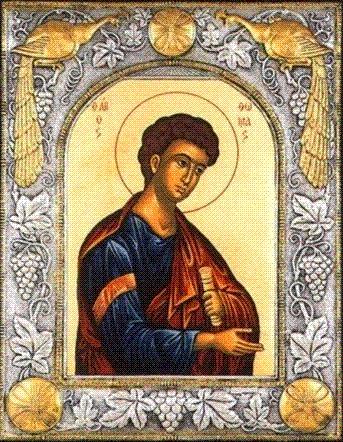
St. Thomas


Today is the feast of St. Thomas, one of this blog's patrons. After expressing doubt that the risen Christ had appeared to the other disciples, Jesus appeared to Thomas and invited him to examine his wounded hands and side.

I have often wondered why Jesus resurrected body would still have his wounds. The account in John's gospel would suggest that this was believed by the Church in the first century! It has been carried forward in religious art. In today's meditation in Magnificat, St. Anthony of Padua relates the wounds of Christ to Isaiah saying that God has written us in the palms of his hands (Isaiah 49.16). St. Anthony gives 3 reasons for this: 1) to show the scars of his wounds to the Father as a reminder of our need for mercy, 2) in order not to forget us, and 3) "He has written in his hands what kind of people we should be and in whom we should believe."

We are all like Thomas. We believe yet we want proof. By his wounds Jesus is telling us as he told Thomas "be not faithless, but believe." (John 20:27). As it says in the Anima Christi, "O good Jesus hear me, within thy wounds hide me..."