Tuesday, July 3, 2007

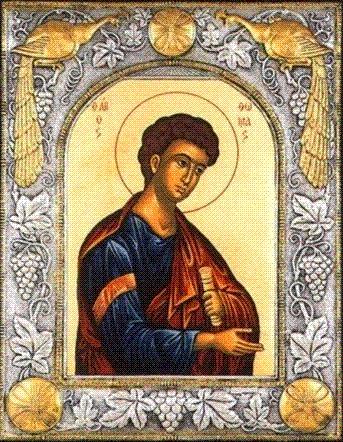
St. Thomas


Today is the feast of St. Thomas, one of this blog's patrons. After expressing doubt that the risen Christ had appeared to the other disciples, Jesus appeared to Thomas and invited him to examine his wounded hands and side.

I have often wondered why Jesus resurrected body would still have his wounds. The account in John's gospel would suggest that this was believed by the Church in the first century! It has been carried forward in religious art. In today's meditation in Magnificat, St. Anthony of Padua relates the wounds of Christ to Isaiah saying that God has written us in the palms of his hands (Isaiah 49.16). St. Anthony gives 3 reasons for this: 1) to show the scars of his wounds to the Father as a reminder of our need for mercy, 2) in order not to forget us, and 3) "He has written in his hands what kind of people we should be and in whom we should believe."

We are all like Thomas. We believe yet we want proof. By his wounds Jesus is telling us as he told Thomas "be not faithless, but believe." (John 20:27). As it says in the Anima Christi, "O good Jesus hear me, within thy wounds hide me..."

Sunday, June 10, 2007

Blessed Francis Faà di Bruno

One of our patrons (see And Now a Word from Our Sponsors, below) is Blessed Francis Faà di Bruno.

If you’re thinking “Faà who?--you’re not alone! Blessed Francis Faà di Bruno was born in 1825, the youngest of 12. He became first a mathematician and later a priest. How late? He was ordained at the age of 51!

Here’s a quote from AmericanCatholic.org (Read the full entry here.)

It wasn’t Francis’ lack of scholarly ability or deep-down goodness that almost kept him from the priesthood, but his bishop’s distrust of “late vocations.” Until the later part of the 20th century, most candidates for the priesthood entered the seminary right out of grade school. Today no bishop would refuse a middle-aged applicant—especially someone whose care for people in need is constant. Francis is a holy reminder that God’s call to reassess our life’s direction can reach us at any age.

Hmm, I’m not sure that “today no bishop would refuse a middle-aged applicant”! But the need for such to show that their late vocation comes from a life of openness to the Holy Spirit’s leading is well taken.
Blessed Francis Faà di Bruno, pray for us!

Saturday, June 2, 2007

St. Thomas--doubting and late!

The disciples are gathered. In fact they are in hiding! Some of them have seen the empty tomb, some have seen the risen Jesus; others have not. Some believe, some doubt.

Then Jesus appears in their midst. They all see him, except Thomas. He is absent. Perhaps he is buying provisions. Perhaps he is off by himself trying to understand the stories he has heard about Jesus being raised from the dead.

Thomas returns. The others tell him, "we have seen the Lord!" Thomas has missed seeing Jesus. Thomas is late. Then he gets defensive. “Unless I see the marks of the nails in his hands and put my hand in his side, I will not believe.”

A week later, the Gospel of John tells us, Jesus again appears to the disciples, who are gathered behind locked doors. After greeting them with “Peace be with you”, Jesus turns to Thomas and invites him to do exactly what he said he needed to do to believe. “Put your finger here and see my hands, put your hand into my side. Be not faithless, but believe.”

Thomas’ answer is “My Lord and my God”. It has echoed down the centuries from the lips of those who, like Thomas, have seen the risen Christ. It is whispered in fervent intensity by Catholic believers when the consecrated bread and wine are presented for a moment of adoration during the Mass, as they affirm the Real Presence of the risen Christ in the Eucharist. Thomas saw Jesus in the flesh by sight. We see Jesus in the flesh by faith. We see him in his Body, the Church, and especially in the Eucharist.

Thomas was late to see the risen Christ. I don’t think it’s too much to say that Jesus appeared that second time to the disciples in order to answer Thomas’ prayer and challenge his faith. Jesus came and appeared to a late and unbelieving Thomas and brought him back into the community of the disciples. Jesus continues to come to the late and unbelieving through the Church and the Eucharist to grant them the opportunity to “not see and believe.”

If Jesus did that for Thomas, can we do any less?

Thursday, May 31, 2007

The Visitation

One of the questions regarding late vocations is "how late is late?" Some religious orders have a cut-off age of 35 or so. They want young postulants and novices because of the time needed not only for spiritual formation but also formation in the community. Diocesan vocations tend to be more flexible. 40 seems to be the usual cut-off age, but they will often consider older candidates who are well qualified.

Today, May 31st, is the Feast of the Visitation. Elizabeth, who was 6 months pregnant when Mary came to visit her, was an older woman. She had been barren, but the Lord had blessed her to be the mother of John the Baptist. Luke writes that Elizabeth was well "advanced in years". Her fruitfulness came late in her life! "Nothing is impossible with God" (Luke 1:37). Every time we pray the Hail Mary, we remember Elizabeth's words to Mary, "Blessed are you among women and blessed is the fruit of your womb!" (Luke 1:42).

If Elizabeth and her husband Zachariah, a Levitical priest, could bring forth life in their later years, giving birth to John the Baptist, then clearly God is not limited by our mortal lifetime. It is never too late with God!